
Multi Agent AI Architecture
Model Context Protocol Service
Model Context Protocol (MCP) is an open communication standard that defines how AI agents discover, connect to, and interact with external tools, data sources, and enterprise systems through structured, machine-readable context.
Deployment models
Extravaganza Model Context Protocol Cloud On-Prem
Cloud On-Prem brings powerful Model Context Protocol service features directly to your infrastructure. Extravaganza Cloud On-Prem enables you to deploy the complete solution with your own environment to meet your company internal needs.
This solution is built for organizations that require enhanced data privacy, strict compliance adherence, and complete infrastructure control. Whether you’re managing critical infrastructure, operating under stringent regulations like GDPR or HIPAA, or simply need the flexibility to customize your environment, Extravaganza Model Context Protocol Cloud On-Prem delivers enterprise-grade solution without compromising on security or control.
Before You Begin
Ensure you have the following ready before starting the installation:
Required:
- Kubernetes cluster configured
- Helm (version 3.12 or newer with OCI Configuration)
- Kubectl with access to Kubernetes cluster
Optional:
- CPU architecture amd64 with AVX2/AVX512 instructions support
Minimal System Requirements:
| Component | Details |
|---|---|
| Kubernetes | Version 1.33 or newer |
| TLS certificate | Single certificate for all endpoints, or separate certificates for frontend, and API. Must be trusted by all connecting entities. |
| Model Context Protocol Cloud services | 1 machine with 2-4 CPU cores, 4-8 GiB memory |
| NVMe/SSD storage | Storage for uploaded resources, 256 GiB for PVCs (cloud services are not ephemeral) |
| Third-party Services | 1 machine with 4 CPU cores, 160 GiB NVMe/SSD storage for PVCs |
Required Components
Third-Party Services
All these components must be installed prior to the Model Context Protocol cloud services:
| Component | Version | Purpose | Notes |
|---|---|---|---|
| MariaDB | 12.x | Main metadata database |
Step by Step Guide to Install
Extravaganza Business Services Model Context Protocol solution
Instead of hardcoding brittle, point-to-point integrations, MCP introduces a standardized way for AI systems to operate across environments.
AI agents can dynamically discover available tools at runtime, rather than relying on pre-configured connections. This means new systems can be introduced without requiring engineering teams to rebuild integrations from scratch.
It defines structured input and output contracts, where each tool exposes clear schemas for what it expects and what it returns. This removes ambiguity and significantly reduces debugging and integration effort.
Model Context Protocol ensures reliable cross-system execution through built-in mechanisms like error handling, retries, and capability negotiation. This is critical for enterprise environments where workflows must execute predictably and securely.
Before MCP, enterprises relied on three primary patterns to operationalize AI: APIs for connectivity, RAG for knowledge retrieval, and custom orchestration layers for workflow automation. Each solves a part of the problem. None solves it end-to-end.
The missing piece is a unified layer that provides standardized context, structured interaction, and dynamic capability discovery. This is exactly what MCP introduces. Not by replacing APIs, RAG, or orchestration—but by wrapping them in an AI-native interface that makes systems discoverable, contextual, and actionable at scale.
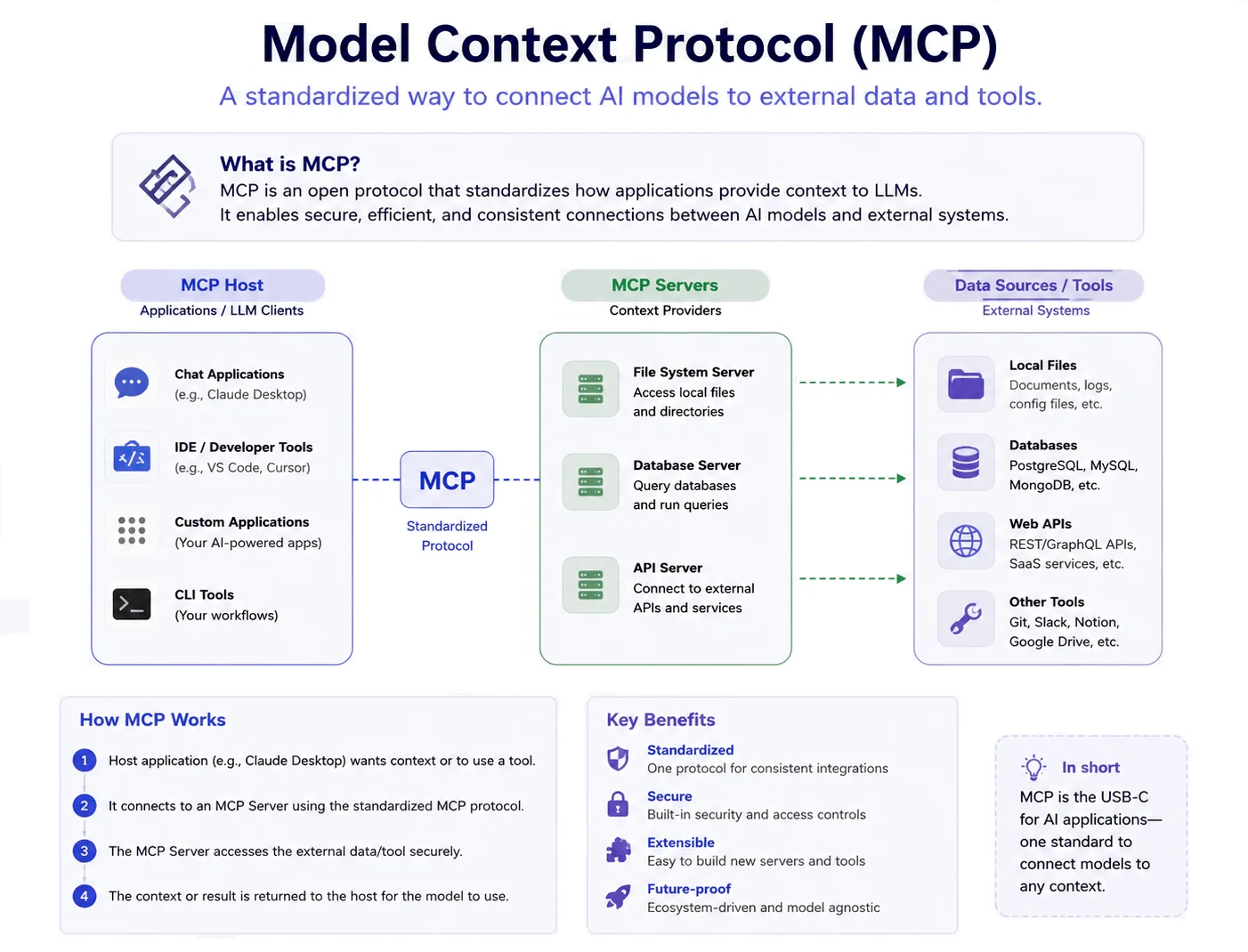
At its core, MCP introduces a standardized client–server architecture that sits between AI models and enterprise systems. Unlike traditional middleware that simply translates data formats, MCP enables capability negotiation – allowing AI agents to dynamically discover, understand, and execute actions across heterogeneous enterprise environments.
MCP operates across three logical layers.
- At the top sits the AI model or agent (the client). This layer interprets user intent, breaks it down into tasks, and requests capabilities needed to complete those tasks.
- In the middle is the MCP protocol layer. This is where the core intelligence of integration lives. It enables agents to discover available tools, understand how to use them through structured schemas, maintain session context across interactions, and handle authentication, validation, and error management.
- At the bottom are MCP servers – these represent enterprise systems such as SAP, Salesforce, Workday, Snowflake, internal APIs, databases, and file systems. Each system exposes its capabilities in a standardized, machine-readable format.
MCP does not compete with APIs, RAG, or orchestration frameworks. Instead, it introduces an AI-native protocol layer that enhances how these existing technologies are discovered, interpreted, and executed by autonomous agents. Understanding this distinction is critical to designing scalable enterprise AI architectures. RAG makes AI informed. MCP makes AI operational.
Main functionalities
- Integrates with multiple resource access protocols e.g NFS, SMB, S3, Dropbox.
- Tools import automation from Open API specification.
- Toolsets versioning.
- Access level protection for LLMs e.g read-only, read-write.
- Tools, Resources (including Templates), Prompts, and Completions support.
- Fully configurable from user interface, no coding required.
- Enterprise grade ready.
- Configurable per agent.
- Auditable per user/organization registered account.
- Ensures confidentiality of data transported between the client environment, and external resource/tool, and LLM model.
- Offers two deployments models depending on the business specific needs and requirements.
Benefits
- Accelerated AI Deployment: MCP eliminates the need for custom integration engineering for every new AI use case. Instead of building connectors from scratch, new systems can be exposed through MCP servers and become immediately accessible to AI agents. This significantly reduces deployment cycles – from weeks or months of integration work to hours of configuration. Faster rollout of AI across business functions, with up to 50–75% reduction in development effort for integration-heavy use cases.
- Truly Scalable AI Agents: Without MCP, AI agents are tightly bound to specific systems and workflows. Scaling them across departments requires architectural redesign. With MCP, agents dynamically discover new tools at runtime. This means a single agent architecture can operate across finance, HR, operations, and customer success – without being rebuilt for each domain. A unified AI layer that scales horizontally across the entire enterprise stack instead of isolated departmental bots.
- Real-Time Operational Execution: Traditional AI systems are limited to insights, recommendations, or dashboards. MCP-enabled systems go further – they execute actions directly across live enterprise systems. Decisions are no longer handed off to humans for execution. Instead, they are carried out in real time across ERP, CRM, HR, and communication platforms. Reduction of decision-to-action latency from hours or days to seconds.
- Radically Simplified Architecture: Enterprise AI integration today suffers from the N×M problem – every AI model must integrate separately with every system. MCP replaces this with a standardized interaction layer, reducing complexity to N + M. Instead of maintaining thousands of brittle point-to-point integrations, organizations manage a smaller number of MCP clients and servers. Up to 70% reduction in integration overhead and significantly lower operational maintenance costs.
- Context-Aware, Accurate Decision-Making: Most AI failures in enterprises are not model failures – they are context failures. MCP solves this by ensuring that context is persistent, structured, and shared across all system interactions. This enables AI agents to make decisions based on complete, real-time enterprise data rather than fragmented snapshots. Higher accuracy, fewer operational errors, and built-in auditability across all AI-driven actions.
- Traditional integration approaches rely on static, point-to-point API connections. MCP replaces this with dynamic, runtime negotiation between clients and systems.
- Instead of pre-configured mappings, tools are discovered on demand.
- Context is no longer manually passed between systems – it is managed as part of the protocol itself.
- Error handling and retries are standardized, rather than implemented separately for each integration.
- And most importantly, MCP is model-agnostic. It works across AI ecosystems – from solutions by Extravaganza or Anthropic to models from OpenAI and Google – without requiring re-engineering.
- AI moves from answering questions based on static knowledge to discovering and executing actions across live systems. From isolated, stateless interactions to persistent, multi-step workflows. From requiring constant human intervention to operating autonomously within defined governance boundaries. From being confined to a single application to orchestrating processes across the entire enterprise stack.
MCP directly addresses the most critical barrier to enterprise AI adoption: moving from isolated pilots to production-scale operational systems. While organizations have rapidly adopted AI agents, integration complexity continues to be the primary constraint to scaling. Most enterprises can build AI capabilities – but struggle to connect them reliably across fragmented systems, governance layers, and legacy infrastructure. MCP removes this friction by introducing a standardized protocol layer that makes AI systems truly operational.