
Inference Framework
To build leading AI products driven by Large Language Models with minimal effort.
- Introduces a layer of abstraction between the user and the hardware, significantly simplifying the way of use.
- Built by developers for developers.
- Integrated with knowledge base.
What Inference Framework is?
It is a set of tools and API functions that helps developers create, optimize, and deploy large language models at scale. In general, it simplifies tasks that would otherwise require lots of manual coding and multiple iterations to achieve similar results and solve hardware compatibility issues.
Deployment models
Extravaganza Inference Framework in Cloud
To start the journey with provided solution please register private or company account for cloud services, accept terms and conditions of services usage and freely use the provided solutions.
Compliant with OpenAI API.
Extravaganza Inference Framework Cloud On-Prem
Cloud On-Prem brings Inference Framework features directly to your infrastructure. Extravaganza Cloud On-Prem enables you to deploy the complete solution with your own environment to meet your company internal needs.
This solution is built for organizations that require enhanced data privacy, strict compliance adherence, and complete infrastructure control. Whether you’re managing critical infrastructure, operating under stringent regulations like GDPR or HIPAA, or simply need the flexibility to customize your environment, Extravaganza Inference Framework Cloud On-Prem delivers enterprise-grade solution without compromising on security or control.
Compliant with OpenAI API.
Before You Begin
Ensure you have the following ready before starting the installation:
Required:
- Kubernetes cluster configured
- Helm (version 3.12 or newer with OCI Configuration)
- Kubectl with access to Kubernetes cluster
Optional:
- CPU architecture amd64 with AVX2/AVX512 instructions support as a GPU acceleration alternative.
- GPU acceleration is recommended. Nvidia CUDA 13.2 (or newer) compatible hardware or Apple Metal is supported.
Minimal System Requirements:
| Component | Details |
|---|---|
| Kubernetes | Version 1.33 or newer |
| TLS certificate | Single certificate for all API endpoints. Must be trusted by all connecting entities. |
| Inference Framework services | 2 machines with 2-4 CPU cores each, 4-11 GiB memory, GPU acceleration is not required but always welcome (with Nvidia CUDA 13.2 compatible hardware or Apple Metal) |
| Third-party Services | 2 machines with 4 CPU cores each, 160 GiB NVMe/SSD storage each for PVCs |
Required Components
Third-Party Services
All these components must be installed prior to the LLM Framework cloud services:
| Component | Version | Purpose | Notes |
|---|---|---|---|
| MariaDB | 12.x | Main metadata database | |
| Kafka broker | 4.x | Broker for internal inter-service communication |
Step by Step Guide to Install
Powered by following models
Accuracy
LLM small
Application
- good for more advanced reasoning and function calling
Features:
- Max context window: 4-8k tokens
Leading languages


Speed
LLM mini
Application
- quite good for chat bot and augmented generation applications
Features
- Max context window: 4k tokens
Leading languages
Cost efficiency
LLM micro
Application
- useful for testing purposes how LLMs work in test environments
Features
- Max context window: 2k tokens
Leading languages
Embeddings models
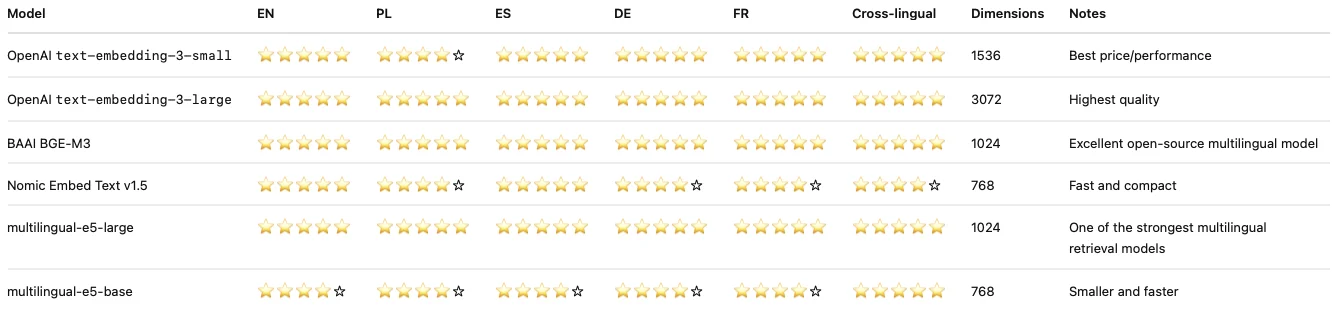
Modern multilingual embedding models perform very well across all of all five supported languages (English, Spanish, German, French, and Polish) and make cross-language semantic search possible.
We offer the following models, depending on needs and applications:
BAAI BGE-M3: one of the best open-source options available today.
- Excellent multilingual quality
- Strong support for European languages, including Polish
- Optimized for retrieval (RAG)
- Performs well on MTEB benchmarks
- Open weights
- ONNX-compatible
- Runs on CPU or GPU
multilingual-e5-base: optimizing for speed, an excellent choice for serving thousands of embedding requests per second.
- Much smaller
- Faster inference
- Lower memory footprint
- Very good multilingual performance
multilingual-e5-large: optimizing for maximum quality, the trade-off is higher memory usage and lower throughput.
- Better semantic understanding
- Better ranking
- Better document retrieval
- Strong cross-language retrieval
Nomic Embed Text v1.5: lightweight option for high-throughput deployments. It is one of the strongest open-source embedding models for production RAG systems.
- Excellent semantic retrieval quality
- Trained specifically for retrieval and RAG workloads
- Supports very long input documents (much longer than many embedding models)
- Strong performance on MTEB benchmarks
- Open weights (Apache 2.0)
- ONNX-compatible
- Runs efficiently on CPU and GPU
- Lower hardware requirements than many “large” models
- Produces highly stable embeddings for document search
- Very good instruction-following (“search_document:”, “search_query:”)
- Excellent for enterprise document search
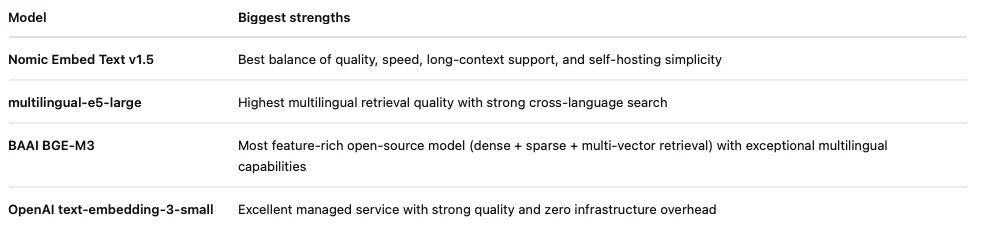
Summary:
Key functions
Responses API: Supports text inputs, and text outputs. Creates stateful interactions with the model, using the output of previous responses as input. Extends the model’s capabilities with built-in tools for file search, web search, computer use, and more. Allows the model access to external systems and data using function calling.
- Responses API
- Conversations API
Platforms APIs: Creates an embedding vector representing the input text, creates and executes a batch from an uploaded file of requests, creates intermediate uploads object.
- Embeddings
- Batch
- Uploads
Vector stores: Powers semantic search for the retrieval API.
- Vector stores
Chat Completions: Generates a model response from a list of messages comprising a conversation.
- Chat Completions
Use cases
- Customer Support Automation: Enables businesses to create AI-powered chat bots that can handle a wide range of customer queries, reducing response times and freeing up human agents for more complex tasks
- Sentiment Analysis: Analyzes customer feedback and detects sentiment, helping businesses understand customer emotions and tailor their products and services accordingly.
- Demand Forecasting: By analyzing historical data and trends, can help enterprises predict future demand for products and services, enabling better inventory management and resources allocation.
- HR and Recruitment: Can streamline the recruitment process by automating resume screening and candidate shortlisting, reducing time and effort spent on hiring.
- Employee Performance Analysis: Can analyze employee performance data to identify areas of improvement and provide personalized training suggestions.
- Product Recommendations: Can offer personalized product recommendations to customers, increasing sales and customer satisfaction.
- Fraud Detection: By analyzing vast amount of data, can help businesses identify and prevent fraudulent transactions in real-time.
- Supply Chain Optimization: Can optimize supply chain management by identifying inefficiencies, predicting potential disruptions, and suggesting optimal routes.
- Document Analysis: Can analyze large volumes of documents, extracting valuable insights and automating manual data entry tasks.
- Natural Language Processing: Can analyze and process textual data from various sources, such as social media, emails, and news articles.
- Image Recognition: Can be used to automate quality control, detect defects in products, and analyze visual data.
- Financial Analysis: Can analyze financial data to identify trends and generate valuable insights, helping businesses make better-informed investment decisions.
- Personalized Learning: Can create personalized learning plans for employees, helping them acquire new skills and improve their performance.
- Competitive Analysis: By analyzing competitor data, can help businesses identify opportunities and threats, allowing them to stay ahead of the competition.
- Content Generation: Can generate high-quality, human-like content for blogs, articles, and social media posts, saving time and resources.
- Cybersecurity: Can detect and respond to cyber threats in real-time, protecting businesses from data breaches and malicious attacks.
- Market research: By analyzing market data, can help businesses identify trends and consumer preferences, enabling them to make data-driven decisions.
API Reference
Inference Framework API is compatible with OpenAI’s API.
See the original OpenAI API reference